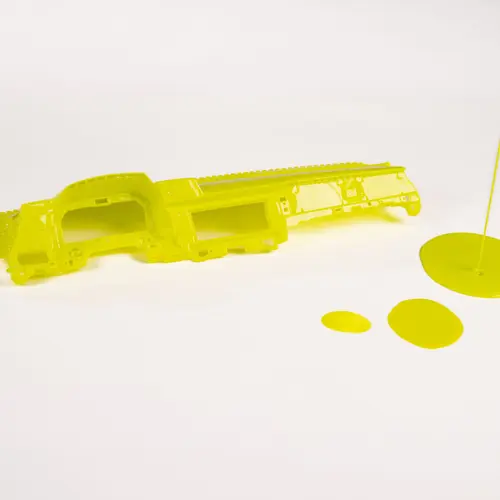
Vacuum casting
Precise prototypes and small series with production-like quality
Vacuum casting with polyurethane (PU) is a highly precise and economical process for the production of prototypes and small series. It is used whenever high-quality plastic components with a near-series appearance are required - quickly, flexibly and in small quantities. This makes it an indispensable part of modern product development.
At its heart is a simple idea: a master mold - usually from 3D printing - serves as a template for a flexible silicone mold. This can be cast several times in a vacuum process. The result: components with outstanding surface quality, high dimensional accuracy and a variety of materials that leaves almost nothing to bedesired.
Maximum data protection
Your data is in safe hands with us
35 years of experience
Resilient prototypes for your projects
Efficiency
Combination of versatility and material diversity
For every industry
From automotive to dentistry
Well advised
Reach your goal quickly with our experts
Maximum data protection
Your data is in safe hands with us
35 years of experience
Resilient prototypes for your projects
Efficiency
Combination of versatility and material diversity
For every industry
From automotive to dentistry
Well advised
Reach your goal quickly with our experts
All answers about vacuum casting.
Vacuum casting at MODELLTECHNIK
PU vacuum casting is perfect for developers who need high-quality components quickly and precisely in small quantities. The process combines the advantages of injection molding with the flexibility of additive technologies - ideal for prototypes and pre-series.

Michael Bauer – Head of Vacuum Casting
Typical application scenarios
Vacuum casting is perfectly suited for small series of up to around 100 units and is economically unbeatable compared to injection molding – especially for product variations or pilot runs. With a wide range of materials available, both functional and visual prototypes can be tested under near-production conditions, whether mechanically or aesthetically. Even complex geometries with fine details, undercuts, or challenging demolding can be easily achieved thanks to flexible silicone molds.
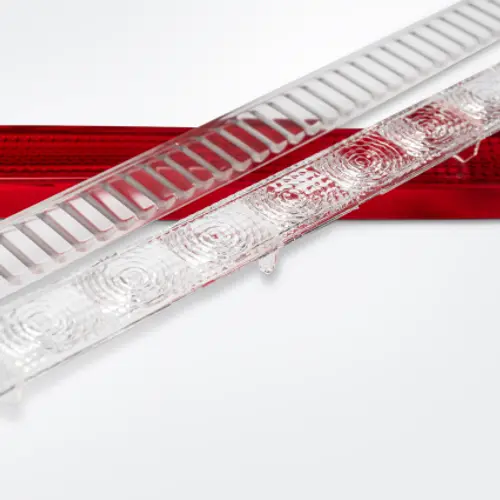
Reflector lenses produced with vacuum casting.
Vacuum casting in pictures


FAQ -Vacuum Casting
- In which industries is vacuum casting used?
- Automotive
Functional parts, design samples and pre-series components – ideal for evaluations, package space testing and customer demonstrations. - Medical Technology
Housings, handles or ergonomic shapes: PU parts can be produced in sterile quality and used for initial applications or regulatory approval steps. - Consumer Goods & Electronics
Production-like prototypes for design validation, marketing samples or first functional tests – including customized colors, transparency or soft-touch surfaces. - Aerospace
Lightweight yet robust components with high precision – suitable for part testing or integration in low-volume programs.
- Automotive
- Why is MODELLTECHNIK the best partner for vacuum casting
Specialized in Prototypes and Small Series
MODELLTECHNIK does not manufacture series products. The focus is on single parts, prototypes, and small series – produced quickly, precisely, and application-oriented.Wide Range of Manufacturing Technologies
In addition to vacuum casting, the portfolio also includes processes such as CNC machining, stereolithography (SLA), selective laser sintering (SLS), and many other methods in prototyping and mold making. This enables the production of components that convince both geometrically and functionally.Expertise Under One Roof
From design to manufacturing and assembly of complete modules – all processes are centralized at MODELLTECHNIK. This ensures short communication paths and high process reliability.Industry Experience and Quality
Whether in medical technology, mechanical engineering, or automotive – MODELLTECHNIK understands the industry-specific requirements and implements them in high-quality models and prototypes. Quality is ensured through a certified quality management system in accordance with DIN EN ISO 9001. You can find out more about our additional certifications HERE.
A body with class: We produced the master model for the body of the cult Evetta light electric vehicle on a 1:1 scale – with perfect milling and the finest surface finishing. Find out how.

The socket for the forest: We developed the prototypes for a type of powerbank for Stihl, which was put through its paces by forestry workers. A truly powerful project.


"Jena, we have no problem": Jena-Optronik commissioned MODELLTECHNIK to produce a 1:1 model of the Gateway Docking Port, which is needed for sensor tests in space applications.
Timeless and dignified: Working with Samosa and our expertise in 3D printing, MODELLTECHNIK creates beautiful templates and design samples for individually designed funeral urns.


Contact us
Whether you’ve got technical, commercial or specialist questions – we’re here to help.
START A QUERY NOW„Spot-on delivery under extreme time pressure [...] It couldn't be more perfect“
„Spot-on delivery under extreme time pressure [...] It couldn't be more perfect“