Fused
Deposition
Modeling (FDM)
Cost-effective prototypes and functional components – manufactured layer by layer with precision.
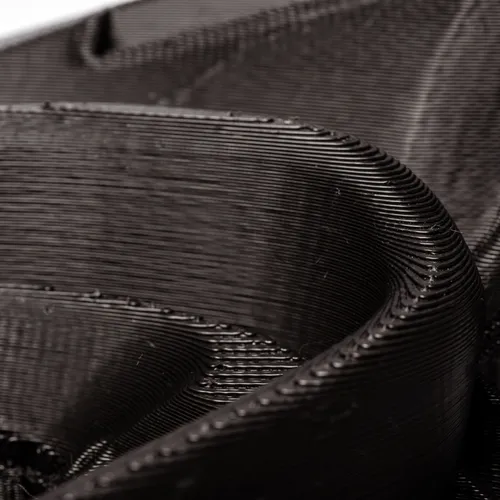
Fused Deposition Modeling (FDM) is an additive manufacturing process based on extrusion-based layer construction. It is one of the most widely used technologies in industrial prototyping and small-batch production. The process is characterized by precise material dosing, high reproducibility, and a wide range of material options.
During the FDM process, a thermoplastic filament is fed into a heated nozzle (hotend) via a feed mechanism. The material is melted and then deposited layer by layer onto a build platform, where it solidifies again. This layering technique enables the creation of three-dimensional components with customized geometries and mechanical functionalities.
Maximum data protection
Your data is in safe hands with us
35 years of experience
Resilient prototypes for your projects
Efficiency
Combination of versatility and material diversity
For every industry
From automotive to dentistry
Well advised
Reach your goal quickly with our experts
Maximum data protection
Your data is in safe hands with us
35 years of experience
Resilient prototypes for your projects
Efficiency
Combination of versatility and material diversity
For every industry
From automotive to dentistry
Well advised
Reach your goal quickly with our experts
FDM Printing: Scalable in size, strong in performance
High material efficiency
FDM builds parts layer by layer with maximum efficiency – no excess waste as in milling or drilling. Support structures are reduced to a minimum and can often be recycled or even reused.
Scalable build volumes
From compact desktop units to large-scale industrial systems – together with our strong partners, we cover the full range of build sizes.
Good mechanical properties
FDM parts are strong, durable, and versatile – from simple prototypes in PLA or ABS to high-performance polymers like PEEK or ULTEM for demanding applications.
Cost-Effective Production
Parts can be produced on short notice without dedicated forming tools, and design changes can be implemented directly from updated CAD data. This simplifies design iterations and makes it easier to produce custom components.
Material Options for Engineering Applications
Material selection depends on the function of the part and whether it requires stiffness, impact resistance, weather resistance, low friction, or elasticity. Fiber reinforcement and specialized formulations broaden the range of options for industrial applications.
Flexibility in Part Size and Design
From compact functional parts to large-format models, we draw on our manufacturing capabilities and partner network to select the right production approach. We tailor wall thicknesses, internal structures, and build orientation to meet weight and load requirements while keeping production cost-effective.


FAQ - FDM Printing
- Advantages of FDM printing at a glance
One of the key advantages of FDM is its cost efficiency. Compared to other additive manufacturing technologies, both the initial investment in printers and material costs are relatively low. This makes FDM particularly attractive for companies that require rapid and economical prototyping, as well as for small-series production where injection molding would be uneconomical.
Another strong point is its ease of use. Modern FDM printers feature automated calibration systems and intuitive user interfaces, making it relatively simple to adopt the technology. Additionally, many systems support open material platforms, allowing the use of a wide variety of filaments—from standard plastics like PLA and ABS to specialized materials with enhanced mechanical or thermal properties.
FDM-produced components can also be mechanically durable and robust. Especially in thick-walled or solid structures, materials such as ABS, PETG, or Nylon offer high stability. In industrial applications, high-performance polymers like PEEK or ULTEM are increasingly used, as they withstand high temperatures, chemical exposure, and mechanical wear.
Another advantage is the scalability of the technology. FDM printers come in various sizes—from small desktop devices for prototyping to large-format machines capable of printing functional parts. Printing parameters can be individually adjusted to meet specific requirements for dimensional accuracy, strength, and surface quality.
- What Are the Limitations of FDM 3D Printing?
FDM-printed parts have visible layer lines and direction-dependent mechanical properties. We account for both when specifying print orientation, wall thickness, and internal structure.
Tight tolerances, specific surface finishes, or leak-tightness requirements may call for additional post-processing or testing.
- How to Select the Right Material for FDM 3D Printing
We start by assessing the part’s function, expected loads, operating temperature, exposure to chemicals or other media, and environmental conditions. We also consider requirements for surface finish, dimensional accuracy, elasticity, flammability, and electrostatic dissipation. Based on these criteria, we work with you to select the right material and define the part design.
- Welche Vorteile bieten CF und GF Varianten im FDM Verfahren?
Carbon and glass fibers can increase stiffness and dimensional stability and, depending on the material, improve heat deflection performance. The suitability of a reinforced grade also depends on expected impact loads, strain requirements, and loading direction. Greater stiffness alone does not guarantee greater toughness or higher interlayer strength.
- FDM in Robotics and Automation
In robotics, FDM enables the production of custom gripper fingers, workpiece fixtures, sensor mounts, and end-of-arm tooling. Lightweight designs can reduce moving mass and free up payload capacity for the workpiece. Tooling can be adapted quickly to changes in part geometry or handling requirements.
Depending on the expected loads, PA12-CF, PA6-CF, PPA-CF, and PET-CF can be used for rigid gripper structures and mounts. TPU grades from 60 to 95 Shore A provide compliant gripping surfaces and protective pads, while foaming TPU Aero grades enable lightweight, cushioned contact surfaces. For handling sensitive electronic components, ABS-ESD offers a static-dissipative material option.
- FDM in medical technology
In medical device engineering, fused deposition modeling (FDM) supports the production of anatomical demonstration models, the development of medical devices, and the testing of patient-specific orthotic and prosthetic components. Geometry, fit, and ergonomics can be evaluated and refined early in the development process.
PLA and PETG are suitable for demonstration models and fit checks. ABS, PC/ABS, and PC are options for durable device housings and functional prototypes. TPU grades with Shore A hardnesses of 60 to 95 and foaming TPU Aero grades with Shore A hardnesses of 65 to 80 provide additional options for flexible pads, cushioning, and prototypes for ergonomic testing. Requirements for body contact, cleaning, or sterilization are assessed for the specific material grade and intended application.
- FDM in aerospace
In the aerospace industry, fused deposition modeling (FDM) supports the development of weight-optimized components and the production of display models, functional prototypes, assembly aids, and test fixtures. Complex geometries and tailored internal structures allow material to be placed precisely where it is needed to meet functional requirements.
Depending on the application requirements, carbon fiber-reinforced materials such as PA12 CF, PA6 CF, PPA CF, and PET CF can be used for rigid fixtures and prototypes subjected to mechanical loads. PPS, PPS CF, and polymers from the PAEK family, including PEEK, offer additional options for applications with more demanding thermal and chemical resistance requirements. Specific requirements, such as those relating to fire behavior, smoke generation, or outgassing, are evaluated separately for the intended application.
- FDM in the Defense Sector
In the defense sector, fused deposition modeling (FDM) supports the development of equipment housings, protective covers, and mounting brackets, as well as the production of functional prototypes, assembly aids, and test fixtures. Custom components can be manufactured without dedicated forming tools and quickly adapted when designs change.
ABS, PC/ABS, and PC are options for durable housings and functional parts. ASA and ASA GF are suitable for applications exposed to weather. Fiber-reinforced materials such as PA12 CF, PA6 CF, and PPA CF provide additional options for stiff, weight-optimized components. Depending on the application, PPS, PPS CF, and materials from the PAEK family, including PEEK, can be considered where greater heat and chemical resistance is required. TPU can be used for flexible protective pads and damping elements.
- FDM for Housewares and Household Appliances
In the development of housewares and household appliances, fused deposition modeling (FDM) enables the rapid production of design models, samples for fit checks, and functional prototypes. Form, handling, and assembly can be evaluated before mass production for components such as handles, closures, mounting brackets, storage organizers, and appliance housings.
PLA and PETG are suitable for visual models and initial functional testing. PP is an option for lightweight, tough components that need to resist exposure to chemicals or other substances encountered in use. ABS, PC/ABS, and PC provide additional options for parts that require durability or heat resistance. Flexible TPU grades can be used for slip-resistant feet, soft-touch grip surfaces, and protective pads. Cleaning, temperature, and any applicable food-contact requirements are assessed for the specific material grade and intended application.
- FDM in prototyping and small series production
FDM enables the rapid and economical production of functional prototypes. In product development, components can be manufactured, tested, and iterated within hours—without the need for expensive tooling.
FDM is also ideal for small-series production, particularly for custom enclosures, spare parts, or specialized components. Companies can respond flexibly to customer requirements without investing in costly manufacturing tools.
- FDM in tool and fixture construction
Beyond end-use products, FDM is also used to produce tools, clamping fixtures, and inspection gauges. Particularly for single-piece or low-volume production, the process offers a cost-effective and fast alternative to traditional CNC machining.
- Material Options — PLA for Display Models and Rigid Prototypes
PLA: A cost-effective material for design models, geometry verification, and fit checks. PLA offers high stiffness and good surface quality, with limited heat resistance.
PLA-CF (carbon fiber-reinforced PLA): A carbon fiber-filled grade for applications that require stiff models and a matte, technical finish. The addition of carbon fibers alone does not make PLA suitable for high-temperature applications.
Typical uses include presentation models, installation fit checks, and prototypes with limited heat exposure.
- Materialvielfalt - PETG für vielseitige Funktionsbauteile Material Options — PETG for a Wide Range of Functional Parts
PETG: A tough, versatile material with good resistance to a wide range of substances and higher heat resistance than standard PLA.
PETG-CF and PETG-GF: Carbon fiber- and glass fiber-reinforced grades, respectively, with greater stiffness and improved dimensional stability compared with their corresponding unreinforced base grades.
PETG+PTFE: A low-friction grade designed for sliding contact surfaces under suitable loads.
Typical applications include housings, brackets, covers, assembly aids, and guides and sliding components subjected to light to moderate loads.
- Material Options — PET-CF for Stiff, Heat-Resistant Components
Carbon fiber-reinforced PET combines high stiffness with low moisture absorption. Suitable grades can achieve significantly higher heat deflection temperatures than many PETG grades, in some cases after a specified heat treatment. PET-CF therefore forms a distinct material class from PETG-CF.
Typical applications include dimensionally stable fixtures, rigid brackets, and engineering components subjected to thermal loads.
- Material Options — PP for Lightweight, Chemical-Resistant Parts
PP: A lightweight, tough polymer with low water absorption and good resistance to a wide range of chemicals. It is well suited to applications involving repeated flexing.
PP-GF30: A grade reinforced with 30% glass fiber for increased stiffness and a higher heat deflection temperature. The reinforcement changes how the material deforms under load compared with unreinforced PP.
Typical applications include industrial containers, components that come into contact with process media, covers, and fixtures exposed to chemicals. Leak tightness is assessed for each application.
- Material Options — ABS and ASA for Durable Engineering Components
ABS: A tough, impact-resistant engineering thermoplastic for housings, panels, and functional prototypes.
ASA: A durable thermoplastic with high UV and weather resistance, particularly well suited to outdoor components.
ABS-GF and ABS-CF: Glass fiber- and carbon fiber-reinforced grades, respectively, offering increased stiffness and improved dimensional stability.
ASA-GF: A glass fiber-reinforced grade that combines the weather resistance of ASA with increased stiffness.
ABS UL 94 V-0 FR: A flame-retardant grade for applications with specified flammability requirements.
ABS-ESD: A static-dissipative grade for handling sensitive electronic components.
Typical applications include housings, vehicle trim panels, outdoor covers, and assembly and workholding fixtures for electronics manufacturing.
- Material Options — PC and PC/ABS for Demanding Mechanical and Thermal Applications
PC: Polycarbonate offers high impact strength and heat resistance for durable functional components.
PC/ABS: A blend that combines the toughness and heat resistance of polycarbonate with the processing characteristics of ABS.
PC/ABS UL 94 V-0 FR: A flame-retardant blend for components subject to more stringent flammability requirements.
Typical applications include equipment housings, covers subjected to mechanical loads, brackets, and functional prototypes for machinery and vehicle manufacturing.
- Material Options — PA6 and PA12 for Tough Functional Parts Subject to Wear
PA12: A tough polyamide with good sliding properties and lower moisture absorption than PA6.
PA12-CF: A carbon fiber-reinforced grade that offers increased stiffness for dimensionally stable engineering components.
PA6: A polyamide suited to mechanically loaded applications and offering good wear resistance. Moisture absorption affects part dimensions, stiffness, and toughness and should be factored into the design.
PA6-CF: A carbon fiber-reinforced grade for stiff functional parts. It can offer a higher heat deflection temperature depending on the grade and conditioning.
Typical applications include guides, gears, assembly fixtures, and functional parts subjected to mechanical loads.
- Material Options — PPA for Demanding Engineering Applications
PPA: A semi-aromatic polyamide for applications with demanding thermal and chemical resistance requirements. Suitable grades are less sensitive to moisture than PA6.
PPA-CF: A carbon fiber-reinforced grade that offers high stiffness and dimensional stability under demanding service conditions.
Typical applications include load-bearing brackets, engineering fixtures, and components exposed to thermal loads in service.
- Material Options — PPS for High-Temperature and Chemical Exposure Applications
PPS: A high-performance thermoplastic with excellent heat and chemical resistance and very low moisture absorption.
PPS-CF: A carbon fiber-reinforced grade with increased stiffness and improved dimensional stability.
Typical applications include machine components, fixtures, and equipment housing parts exposed to heat and chemicals.
- Material Options — PAEK and PEEK for High-Performance Applications
PAEK refers to the family of polyaryletherketones, which includes PEEK. These high-performance thermoplastics combine high heat resistance with the ability to withstand mechanical loads and offer good resistance to chemicals and wear.
The choice of PAEK or PEEK grade and the processing conditions depend on the requirements of the specific component.
Typical applications include high-performance machinery components, functional parts exposed to chemicals, and lightweight components that can replace metal parts in suitable applications.
- Material Options — TPU for Flexible Components and Damping Structures
TPU 60A–95A: Elastomeric grades ranging from soft to relatively firm. Depending on the formulation, they offer high elongation, good elastic recovery, and abrasion resistance.
TPU Aero 65A–80A: Foaming TPU grades for lightweight, soft components that provide cushioning. Hardness and density depend on the grade and the degree of foaming during printing.
Typical applications include gripper pads, protective caps, flexible boots, damping elements, cushioning pads, and seal prototypes. Part compliance can also be tailored through geometry, wall thickness, and internal structure.
- What Should You Consider for Flame Retardancy and Electrostatic Discharge (ESD) in FDM 3D Printing?
Flame-retardant ABS and PC/ABS grades with a documented UL 94 V-0 classification are available for applications with specific flammability requirements. The supporting documentation must cover the material and manufacturing process used. If the classification applies to the raw pellets, its applicability to the printed part must be verified separately.
When selecting an ABS-ESD grade, we consider the required electrical resistance range and the intended service conditions. ESD performance must be verified independently of any carbon fiber reinforcement.
A body with class: We produced the master model for the body of the cult Evetta light electric vehicle on a 1:1 scale – with perfect milling and the finest surface finishing. Find out how.

The socket for the forest: We developed the prototypes for a type of powerbank for Stihl, which was put through its paces by forestry workers. A truly powerful project.


"Jena, we have no problem": Jena-Optronik commissioned MODELLTECHNIK to produce a 1:1 model of the Gateway Docking Port, which is needed for sensor tests in space applications.
Timeless and dignified: Working with Samosa and our expertise in 3D printing, MODELLTECHNIK creates beautiful templates and design samples for individually designed funeral urns.


Contact us
Whether you’ve got technical, commercial or specialist questions – we’re here to help.
START A QUERY NOW„Spot-on delivery under extreme time pressure [...] It couldn't be more perfect“
„Spot-on delivery under extreme time pressure [...] It couldn't be more perfect“